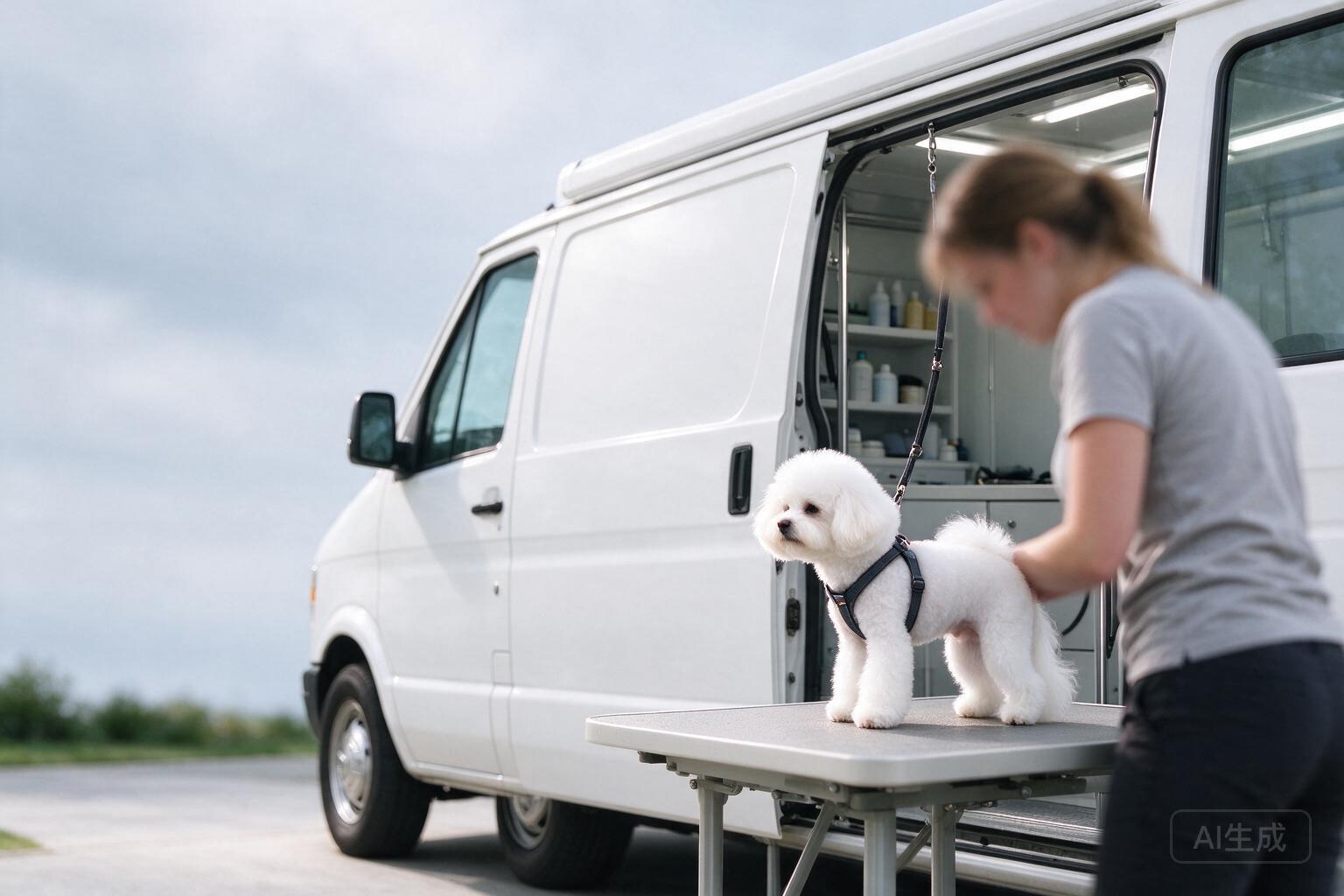

Mobile grooming brings a self-contained salon to your driveway — and a price to match. This guide breaks down what U.S. mobile dog grooming costs, which services sit behind the menu, how quotes are built, and how the format compares with a salon, a self-serve wash bay, or doing it yourself.
What Mobile Dog Grooming Is and How Its Pricing Model Works
Mobile dog grooming is a grooming salon that comes to the customer's property. Instead of driving to a shop and handing the dog over for a drop-off window, the owner watches a groomer pull up in a converted van or trailer, park in the driveway or at the curb, and complete the whole groom on site: bath, blow-dry, haircut or tidy, nails, and ears. The unit is self-contained. It carries its own fresh water, a separate wastewater tank, a water heater, and its own power, so the household does not need to supply a hose or an outlet. Appointments usually run about one to two and a half hours, depending on the dog's size, coat, and the service booked.
Inside the Van, and How an Appointment Runs
A working van is a compact salon on wheels. Typical builds include:
- a grooming tub with a warm-water supply and a non-slip floor
- a height-adjustable grooming table with a restraint arm
- a high-velocity dryer plus clippers, shears, brushes, and combs
- fresh water and greywater tanks, with an on-demand water heater
- a generator or an onboard battery bank running the dryer, heater, lights, and climate control
- climate control and secured storage for shampoos, towels, and tools
The commercial model is one dog at a time. The dog moves from tub to dryer to table without kennel time or waiting behind other dogs, and the groomer's attention is not divided. Multi-dog households are handled differently: rather than two separate visits, the dogs are groomed back to back during a single stop — which is why second and later dogs are commonly quoted at a reduced rate.
Why Mobile Service Carries a Premium Over a Storefront Salon
Mobile grooming is not a salon price with a van attached. The unit of cost is the stop, not the hour at the table. Every appointment carries a share of the vehicle payment, insurance, fuel to get there, fuel to run the generator, water, supplies, and the unpaid minutes between driveways. In one published operator cost breakdown, a solo groomer working roughly 1,200 stops a year reached about $41 per stop before any grooming labor had been paid for, with the van and conversion payment the single largest fixed line at about $9.65 per stop, ahead of a maintenance reserve ($3.00) and insurance ($2.75) (GroomBoard, 2026).
Two structural facts explain the rest of the premium:
- A hard capacity ceiling. Because every appointment involves driving, solo mobile groomers plan on only about four to seven dogs a day, while a busy storefront may handle many times that. Fewer dogs per day means each dog must absorb more of the day's fixed cost.
- Route density. Drive time is the cost a groomer can actually shrink. Clients clustered by neighborhood turn windshield time into table time; a scattered book does the reverse, and the clock is not billed to anyone.
Add the ordinary overheads of any small business — commercial auto and liability coverage, licensing, booking software, accounting, marketing — and the premium reads as cost recovery rather than a pure convenience markup. Estimates of how much more mobile costs than a comparable salon range from roughly 15–30% in one 2026 price guide to 20–40% in an operator-facing pricing guide, or about $20–$40 on a typical groom.
How Fees Are Structured
Most mobile groomers publish a flat rate card rather than billing by the hour, then layer a few charges around it:
- Flat service price by size and coat type, with surcharges for double coats, curly or doodle coats, and dematting.
- A minimum charge per stop, commonly in the region of $50–$75 in published operator guidance, because a 20-minute nail trim costs the same to reach as a two-hour full groom.
- A travel or zone fee outside a core service area; outer-zone fees often land near $20–$35, sized to the extra mileage and drive time.
- A defined service radius, with outlying neighborhoods either surcharged or served only on set days.
- Multi-dog discounts, usually a flat $10–$15 off the second and later dogs rather than a percentage of a large dog's price.
- Occasional fuel surcharges, deposits, or cancellation terms, used when daily routes are tightly booked.
How a Quote Is Built, and Why Price Grids Differ
Quotes are assembled from a handful of variables: size band, coat type and length, temperament and handling needs, coat condition (matting and de-shedding add both time and product), and the duration the groomer expects the work to take. That is why two dogs of identical weight can sit at opposite ends of a listed range.
Published grids also disagree from market to market. In the 2026 guides reviewed here, a small-dog mobile full groom was listed at $55–$90 by one source and $100–$130 by another, while large dogs ranged from $95–$155 up to $140–$170 or more. Geography accounts for much of the spread: one directory estimates that high-cost metros run roughly 30–50% above the national average, while rural and small-town prices sit about 10–25% below it. A single national figure is a planning anchor, not a quote.
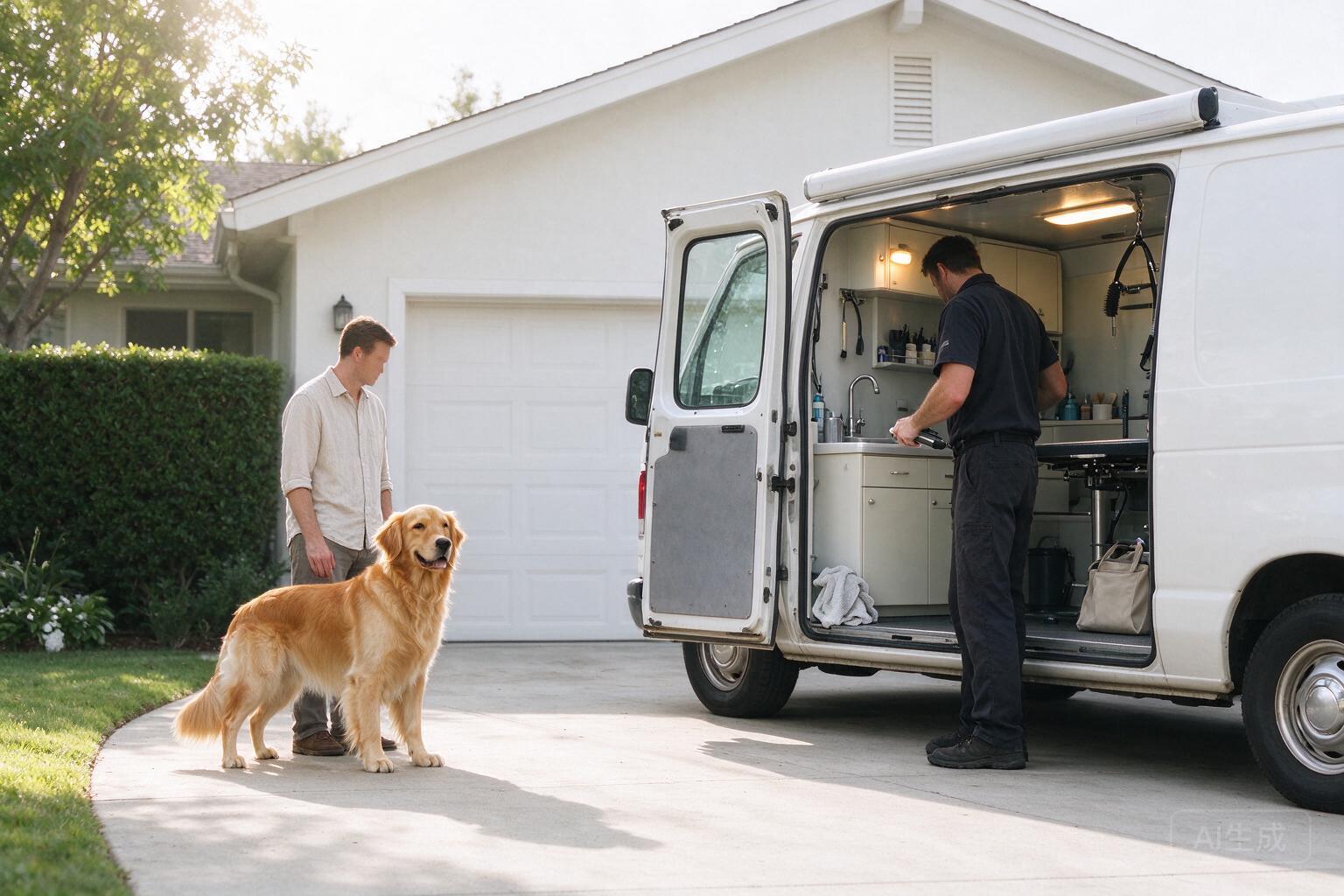
Typical Mobile Dog Grooming Prices in 2026
Mobile grooming does not have a single national price. It has a range that moves with the dog's size, coat, city, and how far the van has to drive. The figures below come from 2026 pricing guides and published mobile rate cards. Unless noted, they are starting prices for a dog in reasonable coat condition that is on a regular grooming schedule — not a firm quote.
Full groom prices by dog size
A full groom generally includes bath, blow-dry, brush-out, haircut, nail trim, ear cleaning, and a sanitary trim.
| Dog size | Mobile full groom, national planning range | Mobile full groom, one mid-market rate card |
|---|---|---|
| Small (under 20 lb) | $55–$90 | $75–$110 |
| Medium (20–50 lb) | $70–$120 | $90–$130 |
| Large (50–90 lb) | $95–$155 | $110–$160 |
| Extra-large / giant (over 90 lb) | $120–$195+ | $150–$200+ |
The first column applies a 20–40% mobile premium to typical salon ranges in 2026 price guidance. The second is a published rate card for a Texas metro area and illustrates why local menus can sit above or below national planning numbers. Dense coastal metros commonly run higher than inland ones.
Coat type changes the price
Weight is only the first variable. Coat length, density, and condition add time, product, and skill:
| Coat type / example breeds | Typical mobile surcharge on a groom |
|---|---|
| Double coat (Husky, Golden Retriever, Shepherd) | +$10–$35 |
| Curly / doodle coat (Poodle, Goldendoodle) | +$20–$40 |
| Short coat (Labrador, Beagle, Boxer) | Usually no surcharge |
| Long, fine coat (Shih Tzu, Maltese, Yorkie) | Priced at the upper end of the size band |
A doodle full groom commonly lands around $130–$180 in published mobile pricing guidance, while short-coated breeds are the only group where a mobile visit is essentially a bath-and-nails service.
Bath-only and mini groom pricing
| Dog size | Mobile bath & tidy (no haircut) | Mobile bath & brush (metro rate card) |
|---|---|---|
| Small (under 20 lb) | $35–$65 | $50–$75 |
| Medium (20–50 lb) | $50–$85 | $65–$90 |
| Large (50–90 lb) | $65–$105 | $80–$110 |
| Extra-large (over 90 lb) | $85–$135 | $100–$140 |
Neither source publishes a separate "mini groom" line. In practice a mini groom — bath, blow-dry, face/feet/paw tidy, nails, ears — falls between the bath-and-tidy and full-groom price. Some groomers simply quote a full groom minus the haircut.
Individual services and add-ons
| Service | Mobile price range |
|---|---|
| Bath & brush | $45–$90 (size dependent) |
| Full haircut / full groom | $75–$175+ |
| Nail trim | $15–$25 |
| Nail grinding (Dremel) | $18–$30 |
| Ear cleaning | $10–$20 |
| Teeth brushing | $10–$15 |
| De-shedding treatment | $30–$60 |
| Flea & tick or medicated bath | $25–$45 (medicated shampoo add-on $10–$20) |
| Sanitary trim | Often included in a full groom; ask |
| Anal gland expression | $15–$25 |
| Paw / pad trim ("pawdicure") | $20–$35 |
| Face trim | Usually bundled with a full groom |
Inclusion varies by operator, so a $95 quote and a $120 quote are not always comparable.
Travel fees, minimums, and the real total
Travel is usually built into the base price, but two other mechanisms appear on menus. Some operators charge a small trip fee, typically $5–$15 depending on distance. Others use zone pricing, where a stop outside the core service radius adds roughly $20–$35. Because each visit carries a fixed cost of about $41 before any grooming happens, many groomers set a minimum ticket in the $50–$75 band, which makes standalone nail trims uneconomical.
Tipping is customary and is not part of the quoted price. The common guideline is 15–20% of the service cost, which is roughly $20–$27 on a $135 groom. Tips trend higher for anxious or senior dogs, longer drives, and time-consuming work like de-shedding or mat removal.
Deposits, cancellation terms, and surcharges
Mobile operators commonly require a $20–$25 deposit or a card on file, with a 24-hour cancellation window. Expect these as standard rather than negotiable.
Surcharges to budget for:
- Heavy matting: +$15–$50 by severity, or $20–$35 per 15 minutes of de-matting work.
- Difficult temperament: +$10–$25 for anxious, reactive, or hard-to-handle dogs, framed as compensation for extra time and safety precautions.
- Senior dogs: not a standard line item, but slow or fragile dogs often fall into the handling-fee category.
- Same-week or emergency booking: operators are advised to price same-day requests at a premium; published amounts are rare, so ask before booking.
Stacking is realistic. A matted doodle booked on short notice can carry a base groom, a curly-coat surcharge, matting time, a handling fee, and a tip — turning a $120 menu price into a total closer to $180. Budget the add-ons, not just the sticker price.
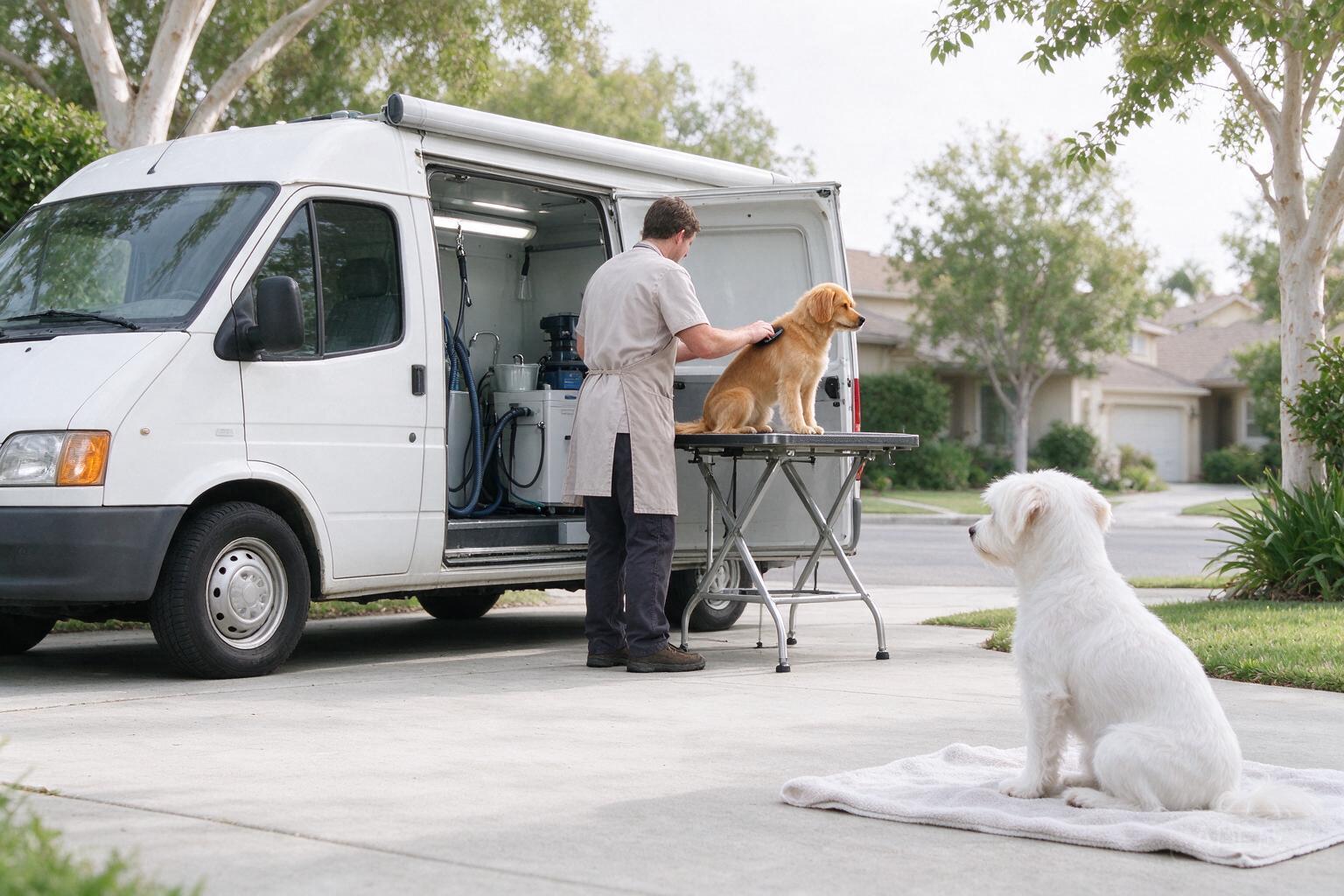
What's Included in a Mobile Grooming Appointment
Mobile grooming brings the salon to your driveway, but it is still a full appointment performed on one dog at a time. The catch is that "full groom" is a marketing label rather than a standardized package. Published menus vary: some mobile services list nails, ears, teeth and a sanitary trim in the full groom but price the haircut separately, and some salons book a "groom with cut" as a separate appointment.
The standard service menu, item by item
- Bath with a dog-specific shampoo. Canine skin differs from human skin, so groomers use dog shampoo, often plus conditioner. Specialty or medicated shampoos are usually an add-on, and a genuine skin problem belongs with a veterinarian, not a guess in a van.
- Blow-dry and brush-out. The American Kennel Club describes the professional sequence as brushing or combing out mats before the bath, then bathing, drying and finally trimming or clipping. In a van, a high-velocity dryer does most of the drying work.
- Haircut or style. Either a breed-style pattern or a simple clip length agreed with the groomer — typically the longest step of the appointment.
- Nail trim or grind. Clipping is quicker; grinding smooths the edges. Nail-care guidance from animal-welfare organizations notes that nails should be trimmed when they almost touch the ground while the dog stands, and that trembling, freezing or snapping during nail work are distress signals to respond to rather than push through.
- Ear cleaning. Normally an external wipe, with plucking on request. Groomers also watch for signs of infection — a reason to see a vet, not a diagnosis.
- Teeth brushing. Surface brushing only; dental disease is veterinary work.
- Sanitary trim and paw-pad trim. Hygiene clipping around the rear and belly, plus hair cleared from between the pads for grip.
- Finishing. Cologne or finishing spray and a final look-over.
Bath & brush, mini groom and full groom
The tiers generally stack like this. A bath & brush covers wash, dry, brush-out and basic hygiene such as nails and ears without changing coat length. A mini groom or tidy adds light trimming of face, feet and sanitary area between full grooms. A full groom adds a complete haircut and shaping on top of the bath and hygiene work. Since definitions vary by business, confirm which tier a quote actually covers.
What a grooming appointment is not matters just as much. Hand-stripping for wire coats is usually a specialist add-on, and show-style scissored cuts are rarely offered in a mobile setting. Dematting is typically capped by time — many groomers bill mat removal in short increments or recommend a close clip instead of hours of combing, and a reputable one discusses that with you first. Anal-gland expression is often by request only. Veterinary care, prescription treatment, sedation and anesthesia sit outside grooming scope entirely.
How long the van takes — and why the coat decides
A mobile appointment commonly runs about one to two hours for a bath & brush, with full grooms on large or heavily coated dogs running longer. Size, coat density, matting, tolerance of the dryer and the number of add-ons all shift that estimate. Senior and anxious dogs may be split into shorter sessions rather than pushed to finish in one sitting.
What the van setup means for your dog
Purpose-built units carry a tub, grooming table, high-velocity dryer, fresh and gray water tanks, and their own power and climate control. Industry reporting on van builds puts typical fresh-water capacity at roughly 30 to 60 gallons — enough for several dogs, with refills or early finishes when a route runs long. Because the groomer works one dog start to finish, your dog is not kenneled to air-dry while other dogs are handled.
The limits are practical: water and power capacity, generator noise, extreme heat or cold, driveways that are steep, blocked or too low for the van, parking rules, and floor space for giant breeds. Some operators still ask for a hose connection or an outdoor outlet.
Preparing, and what to ask before booking
Have the dog exercised and empty, share health conditions, medications, allergies and any past bite history, keep other pets indoors, and clear driveway access. Ask:
- What exactly is included, itemized, at the quoted price?
- Which shampoos and products are used?
- Hand-dry or cage-dry, and how do you handle a dog that dislikes the dryer?
- What is the matting policy, and will you call before clipping short?
- What happens if my dog is aggressive, unwell or overly stressed?
- Do you need water, power or a particular parking spot?
- Are you insured, and how long will my dog be in the van?
If a dog has a skin, ear, dental or mobility problem, the question for the groomer is what they will and will not do; the question for your veterinarian is what the condition needs.
Mobile Grooming vs Salon vs Self-Serve Wash: Cost and Value
Most of the price gap between the three main grooming formats comes down to three things: how much paid labor time a dog consumes, how much travel is involved, and how much facility overhead has to be covered. A salon spreads rent, equipment and staff across several dogs at once. A van carries its entire cost structure to one driveway at a time. A self-serve bay sells you a tub and a dryer and hands the labor to you.
What each format actually costs
The ranges below come from published U.S. grooming price guides, regional provider price lists and self-serve station pricing. They are ranges, not quotes — local markets vary widely, and coat condition moves the number more than breed does.
| Format | Typical price (pre-tip) | Time investment | Considerations for the dog | Best-fit owner |
|---|---|---|---|---|
| Mobile van (self-contained) | About $55–$90 for a small-dog full groom; $120–$195+ for large and giant breeds; commonly 20–40% above the local salon price | Roughly 1–2 hours on site, no driving | One dog, one groomer, no kennel wait | Tight schedules, anxious or senior dogs, owners without a suitable vehicle or tub |
| Storefront salon | Roughly $40–$80 for a small-to-medium full groom in commonly cited price guides; more for large, double-coated or heavily scissored dogs | Often a 3–4 hour round trip once drop-off, waiting and pickup are counted | Other dogs on site, drying kennels and background noise suit some dogs and not others | Dogs relaxed in a salon setting, budget-first owners, very large dogs that benefit from two handlers |
| Self-serve wash bay | About $10–$25 per timed session | 15–30 minutes in the bay, roughly 60–75 minutes including the drive | Owner is present the whole time | Routine baths, owners who want control, households with no suitable tub at home |
| Do-it-yourself at home | No service fee; you pay only for shampoo and supplies | 30–60+ minutes plus cleanup | Familiar surroundings, but home drying is hard to do well | Small, cooperative dogs and maintenance baths where no haircut is needed |
The hidden costs that don't appear on the sticker
- Travel and waiting. A self-serve session is 15–30 minutes of actual work but about an hour of your day once the drive is included. A salon groom is usually 45–180 minutes of appointment time inside a four-hour hole in your schedule.
- Trip and zone fees. Mobile pricing often adds $20–$40 on top of a comparable salon groom, plus a trip fee tied to how far you sit from the van's existing route.
- Tipping. Customary gratuity for a groomer runs 15–20%, which is a real addition to any of the professional formats.
- Add-ons. Matting, compacted undercoat and difficult handling are routinely billed as extra labor; a matted coat can turn a trim into a shave-down. Curly and doodle coats may carry a sizeable surcharge.
- Home cleanup and gear. Bathing at home means wet walls, dog hair in the drain, extra laundry, and eventually buying your own dryer and clippers.
- Prepaid packages you don't use. Multi-wash memberships only save money if you genuinely bathe the dog that often.
When the mobile premium is genuinely worth it
Mobile service earns its price when the alternative costs you something you value more than money. Households with several dogs on a fixed grooming rhythm usually find the per-dog premium adds up fast, so this is worth costing out honestly rather than assuming convenience wins. The premium tends to hold up in a few specific situations: anxious dogs that shut down in a busy salon, senior or mobility-limited dogs that struggle with a car trip and a kennel wait, owners without a car or with limited mobility, very tight schedules, and dogs that are reactive or simply cannot cope with a room full of other animals. A single-dog household with a calm dog and a free Saturday is a different calculation.
When a salon or self-serve bay is the better value
If budget is the deciding factor, a salon is cheaper and a self-serve bay is cheaper still. A very large or heavily coated dog that needs two handlers may also be better served by a salon's staff and equipment. And when a bath is all the dog needs — no haircut, no styling — the self-serve bay is the value answer, provided you are willing to do the scrubbing.
"Mobile" and "house-call" are not the same thing
A mobile groomer works out of a self-contained van parked outside your home, with its own water, power and tub. A house-call groomer travels to you but grooms inside your house, typically in your bathroom or a space you provide, using your facilities. Vans are run both by independent owner-operators and by larger multi-van companies, and the pricing model often differs: independents may price per dog by size and coat, while multi-van operators frequently route by neighborhood and charge zone-based travel fees.
How to Budget for Mobile Grooming and Vet a Groomer
A mobile groom costs more per visit than a salon trim, so the number that matters is not the menu price but the yearly total: price per visit, multiplied by how often your dog's coat actually needs professional work, plus add-ons and tips. The second half of a sound grooming budget is choosing the right groomer, because a well-maintained coat and a clear price list are what keep costs predictable.
Match grooming frequency to your dog's coat
The American Kennel Club notes that how often a dog needs a professional depends on the coat itself, how well the owner maintains it at home, and the local climate. Typical planning ranges:
- Short, smooth coats (Beagle, Boxer, Labrador-type): brushing about weekly; professional bath and nail work roughly every 6–10 weeks, or less often if you handle nails at home.
- Double coats (Golden Retriever, Husky, Shepherd): brushing two to three times a week, plus a professional bath and de-shed every 6–12 weeks. Coat-care guidance advises against shaving a double coat unless matting is severe enough that the skin cannot dry.
- Curly and poodle-type coats: continuous growth means trims every 4–6 weeks, with line brushing between visits.
- Long, silky coats (Shih Tzu, Maltese, Yorkie): every 4–6 weeks for trims and tidy-ups.
Translated into visits per year: a curly-coated dog at 4–6 week intervals is 9–13 appointments; a double-coated dog at 8–12 week intervals is 4–6; a short-coated dog is 4–8. That spread alone can triple one household's grooming bill compared with another's.
Estimate annual spend with simple arithmetic
Start with a real quote, then build the year:
Annual estimate = (base groom + coat surcharge + add-ons) × visits per year + tips
Published 2026 mobile pricing used for planning puts full grooms at roughly $55–$90 (small), $70–$120 (medium), $95–$155 (large) and $120–$195 or more (XL), with surcharges of about $10–$35 for double coats, $20–$40 for doodle and curly coats, $20–$35 per 15 minutes of de-matting and $12–$28 for nails added to a groom. Nails-only visits usually carry a minimum in the $50–$75 band because the trip costs the same regardless of duration.
Illustration, not a quote: a medium curly-coated dog at $70–$120 plus a $20–$40 curl surcharge runs about $90–$160 per visit. At eight visits a year that is roughly $720–$1,280, or about $830–$1,540 once a customary 15–20% tip is included. Run the same math with your groomer's actual numbers before committing to a schedule.
Ways to control cost without skipping care
- Brush at home. Weekly brushing with a slicker brush followed by a comb is the baseline for double coats; daily or every-other-day brushing is the norm for curly and long coats. Consistent brushing is the single biggest defense against de-matting fees.
- Book bath-and-tidy visits between full haircuts. Bath-only or bath-and-brush appointments keep the coat clean and extend the life of a trim.
- Bundle services. Nail trims and ear cleaning added to an existing groom cost less than a separate stop.
- Schedule ahead and stay on the calendar. Off-peak weekdays and pre-booked recurring slots are often easier for the groomer to route, and regular spacing avoids emergency shave-downs.
- Book multiple dogs in one appointment. Mobile pricing commonly discounts a second dog at the same address by roughly $10–$15, because the trip is shared.
- Keep the coat mat-free. Matting converts a routine groom into a longer, more expensive session and can change what is physically possible in one visit.
- Ask for the maintenance plan at pickup. Groomers will usually tell you when to rebook to avoid overgrowth.
A consumer-protection checklist for choosing a mobile groomer
- Confirm the business holds a current state or local business license, and ask to see a certificate of insurance rather than a verbal assurance. Animal bailee coverage, where offered, addresses injury to a pet in the groomer's care, which general liability alone often does not.
- Ask about certifications and continuing education. The National Dog Groomers Association of America, for example, offers a National Certified Master Groomer credential involving a written exam and practical testing, and other bodies offer safety-focused credentials.
- Read recent reviews, and look for comments about safety, cleanliness and how the groomer handled anxious or senior dogs.
- Ask what happens in an emergency: whether a first-aid kit is aboard, which veterinarian or emergency clinic is used, and how you would be contacted.
- Ask for the matting policy in writing — including whether the groomer will de-mat, clip short, or stop and send you home.
- Ask about sedation. Any sedative is a veterinary decision; ask your veterinarian rather than accepting medication from a groomer.
- Get the price in writing, including surcharges, travel fees and payment timing.
- Confirm cancellation, late-arrival and no-show terms before booking.
- Check the van: a clean, well-ventilated, temperature-controlled workspace with secured restraints and a non-slip table.
- Confirm your dog will not be left unattended in the van or on the table during the appointment, and that water and ventilation are maintained throughout.
Where grooming ends and veterinary care begins
Groomers can flag lumps, soreness, ear discharge, cracked pads or skin problems, but they do not diagnose or treat them. If your dog has itchy, red, broken or infected skin, recurring ear issues, or a lump you have not had checked, contact your veterinarian; medicated baths and skin treatment are veterinary decisions, not grooming add-ons.
The Bottom Line
Mobile grooming is a convenience product priced like one: you are paying for a self-contained van, a groomer's undivided attention, and the drive time it takes to reach your door, which is why the same groom that costs $55–$90 for a small dog costs $120–$195 or more for a giant breed, and why the bill climbs faster still with matting, doodles and heavy double coats. The format is worth the premium when the alternative costs you more in time, stress or safety — an anxious rescue, a senior dog that cannot manage a kennel, two dogs and no free afternoon. For a calm short-coated dog and an open Saturday, a salon or a self-serve bay remains the cheaper answer.
Either way, the reliable way to keep a grooming bill predictable is the same: know the dog's coat cycle, get the price in writing including surcharges, brush between visits, and treat anything medical as a question for a veterinarian.
Sources
- GroomBoard, "Mobile Dog Grooming Prices 2026: What to Charge and the Math Behind It" — https://groomboard.com/blog/mobile-dog-grooming-prices
- GroomFetch, "How Much Does Mobile Dog Grooming Cost? (2026 Price Guide)" — https://groomfetch.com/guides/mobile-dog-grooming-cost
- Mobile dog grooming price card, Fort Worth, TX (2026) — https://www.chewbarkagrooming.com/how-much-does-mobile-dog-grooming-cost-in-fort-worth-tx
- American Kennel Club, "Why It's Worth Having Your Dog Groomed Professionally" — https://www.akc.org/expert-advice/health/why-its-worth-having-your-dog-groomed-professionally

